
Deliberate Practice

Practice is the single most important factor in the control of learning. Some might think the more we practice the more we learn, but if there is no quality or substance in that practice then learning is slow and tedious. It has been suggested that at least 10 years of effortful practice under optimal training conditions is required to reach international-level performance (Ericsson, 1996, 2003; Ericson et al., 1993). Optimal conditions require a well-defined task of appropriate difficulty for the athlete, information feedback, and sufficient opportunities for repetition and correction of errors. Deliberate practice is a training activity that contains all of these elements (Williams, 2010).
Intent
Deliberate practice isn’t enough to enable athletes to learn a skill correctly. For a practice to be effective the athletes must be motivated to learn. Athletes must practice with the intent to improve. Rowing Fitness allows for this by providing daily competition so that athletes come to practice constantly motivated to improve their performance. Deliberate practice and the motivation to improve through daily competition is what Rowing Fitness seeks to provide and teach.
Daily Challenge 5/9:
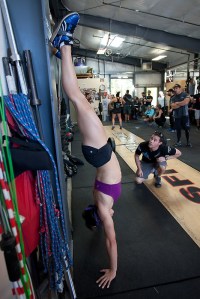
Pick a goat and put in 10 minutes of deliberate practice.
Share what goat you’re working on and what your focus and motivation was during the 10 minutes!
References
Ericsson, K. A. (2003). Development of elite performance and deliberate practice: An update from the perspective of the expert performance approach. In J. L. Starkes & K. A. Ericsson (Eds.), Expert performance in sports: Advances in research on sport expertise (pp. 49-83). Champaign, IL: Human Kinetics.
Ericsson, K. A. (1996). The acquisition of expert performance: An introduction to some of the issues. In K. A. Ericsson (Ed.), The road to excellence: The acquisition of expert performance in the arts and sciences, sports, and games (pp. 1-50). Mahwah, NJ: Erlbaum.
Ericsson, K. A., Krampe, R. T., & Tesch-Romer, C. (1993). The role of deliberate practice in the acquisition of expert performance. Psychological Review, 100, 363-406.
Williams, J. M. (2010). Applied sport psychology (J. M. Williams, Ed., 6th ed.). Boston, MA: McGraw Hill.
 Renegade Rowing