Video Review: Coach Pat – The Squat and Rowing – How well do you perform these movements?

One of the First Renegade Rowing Athletes to become a Firsthand Athlete!

One of the First Renegade Rowing Athletes to become a Firsthand Athlete!

When’s the last time you performed a Squat?  When’s the last time you sat in a chair or got in a boat?  For many of you in Boston and the Northern states it’s been a while, but that ice is almost gone and regular water practices will be happening in no time.  Regardless, anytime you sit or stand up you are squatting, because that’s what a squat is.  It’s the strongest, most efficient, most powerful way to get your body up out of a chair or seated position.

I believe that if you can learn to squat correctly you can and will become a better rower.  The key is how you squat and what you focus on.  Here is a little video review of a pre-elite rower I’ve started working with.  This is her form before any coaching. Check out what she’s doing well and what she can do better.

Now take a look at my squat and rowing below.  What parts of the squat can we tie to the rowing stroke?  I always teach the skills of 1. Posture, 2. Control, and 3. Connection whether it’s rowing or weightlifting.

1. Posture – How am I doing at maintaining a solid brace through my torso?  Is there any movement within the vertebrae of the spine?

2. Control – Is the bar traveling in a straight line over the middle of my foot?  Am I in control of my body and the bar? Can I stop at any point in time and be in a strong position?

3. Connection – How am I connected to the bar?  How am I connected to the floor?  Are my hips, hands, and shoulders connected as I go to stand?

After taking a look and answering some of these questions, think about your own stroke.  In the front end of your stroke, from 1/2 slide up to the catch and back, how do your joints move in relation to one another and what does your body angle look like?  How much distance is there between your butt and your heals?  Do you feel or see any similarities when you squat and row back to back?  Can perfecting one movement help improve the other?

Please share your thoughts to comments and I’ll get back to you with feedback.
Video Review: Coach Pat – The Deadlift and Rowing – How well do you perform these movements?

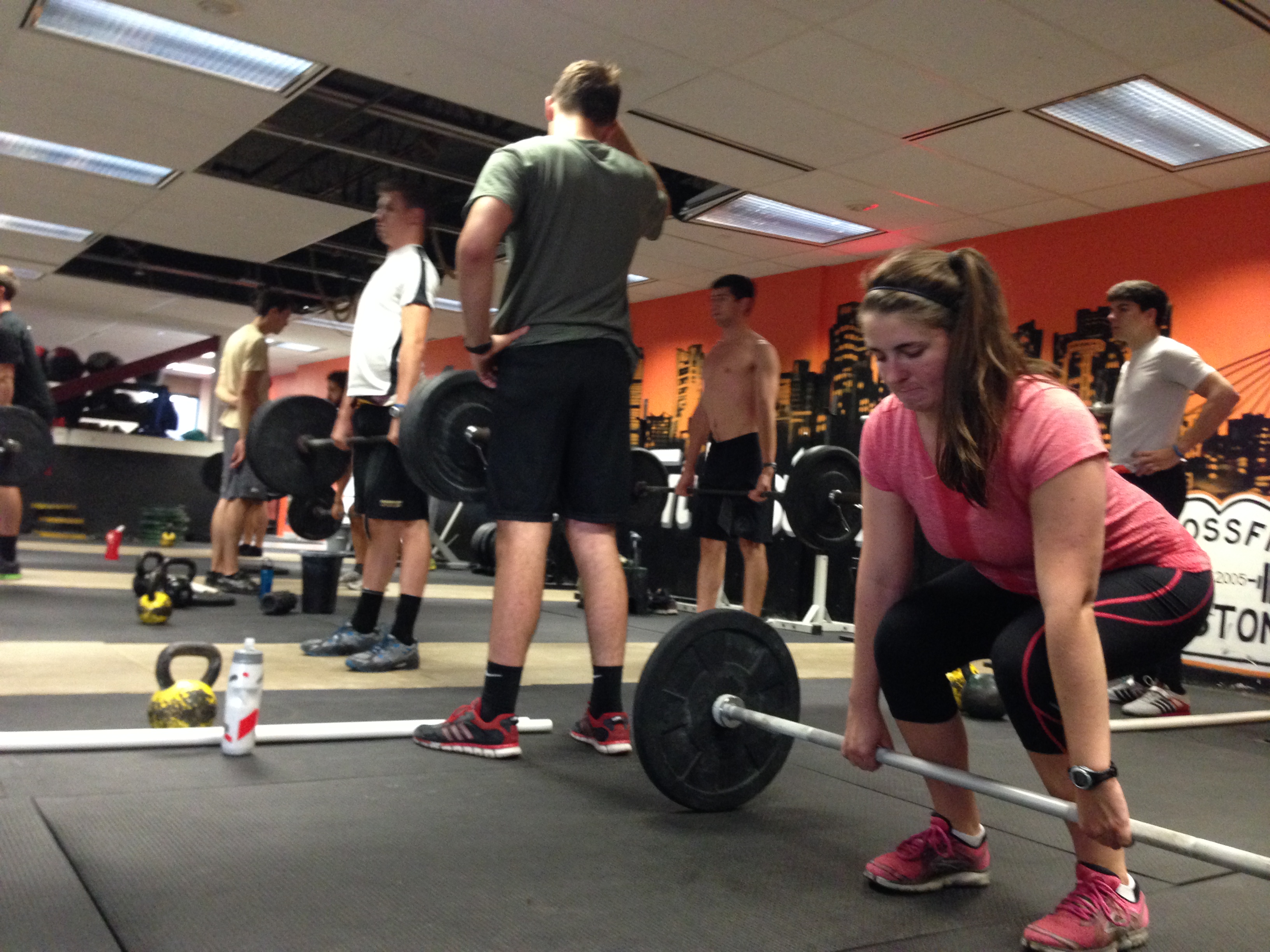
Coxswains getting after the Deadlift last winter!

Coxswains getting after the Deadlift last winter!

When’s the last time you performed a Deadlift?  When’s the last time you picked the boat up out of the water?  For many of you in Boston and the Northern states it’s been a while, but that ice is almost gone and regular water practices will be happening in no time.  Regardless, anytime you pick something up you should be deadlifting, because that’s what a deadlift is.  It’s the strongest, most efficient, most powerful way to pick something up off the floor or out of the water.

I believe that if you can learn to hip hinge and deadlift correctly you can and will become a better rower.  The key is how you deadlift and what you focus on.  Here is a little video review of a pre-elite rower I’ve started working with.  This is her form before any coaching. Check out what she’s doing well and what she can do better.

Now take a look at my hip hinge and deadlift below.  What parts of the deadlift can we tie to the rowing stroke?  I always teach the skills of 1. Posture, 2. Control, and 3. Connection whether it’s rowing or weightlifting.

1. Posture – How am I doing at maintaining a solid brace through my torso?  Is there any movement within the vertebrae of the spine?

2. Control – Is the bar traveling in a straight line over the middle of my foot?  Am I in control of my body and the bar? Can I stop at any point in time and be in a strong position?

3. Connection – How am I connected to the bar?  How am I connected to the floor?  Are my hips, hands, and shoulders connected when the bar is below the knee?

After taking a look and answering some of these questions, think about your own stroke.  In the front end of your stroke, from 1/2 slide up to the catch and back, how do your joints move in relation to one another and what does your body angle look like?  Does it stay the same?  When does your body start to swing open?  Do you feel or see any similarities when you deadlift and row back to back?  Can perfecting one movement help improve the other?

Please share your thoughts to comments and I’ll get back to you with feedback.

RR Training Plan and Rowing WOD 3/23/15: “The Castle” – 21min Row, Varying Rates – Post Distance

Snapshot of the RR Training  Plan for the week of 3-23-15

Snapshot of the RR Training Plan for the week of 3-23-15

Here’s our plan for the week!  Get fired up and hit it hard.  The warm weather is coming!

RR Training Plan 3-23-15

Rowing WOD:

Imagine doing this on the water!  You can with a Renegade Rowing Membership.

“The Castle”

Row for 21min as follows…

3′ @20 s/m, 3′ @24, 3′ @28, 3′ @26, 3′ @28, 3′ @24, 3′ @20

  • Focus on Rhythm and Ratio

As we start to look forward to the fall head racing season, many athletes will need some extra time on the erg to focus on rhythm, timing, and overall form.  Today’s Rowing WOD is a great opportunity for any athlete, experienced or not, to get a sense of form and rhythm without the pressure of intensity and competition.  Sometimes it’s good to slow down for an active recovery day in order to go harder and faster later on down the road.

Rhythm and Endurance are two necessities for successful competition in longer WODs.  A great example would be the KB Swings and Pull Ups found in “Helen”.  Those who find a consistent rhythm can flow through the movements naturally and rely on their aerobic endurance without dipping into their anaerobic energy supply.

In today’s Rowing WOD the focus is developing rhythm and endurance.  Another word for rhythm in rowing is Ratio.  By varying the ratio of the drive to the recovery rowers can maintain the same pace or split, but work more efficiently and make the stroke feel lighter or heavier.

When going from a 20 stroke rating to a 24 you should focus on more pressure with the legs and quickly redirecting the hands through the finish.  This will help increase the stroke rating while leaving you the same amount of time to sit up, breathe, and relax as you slide forward on the recovery.

Post distance rowed to comments along with songs that helped you stick to each rating!

A project that I’ve started thanks to Renegade Rower Mike T. is how to help people feel the proper rhythm and ratio by rowing to music.  Music can motivate us to push hard and row longer, but it can also give us a sense of timing.

If you have Spotify, I’ve created a playlist for each stroke rating.  Each playlist is named “Renegade Rowing @(insert stroke rate)”, so for songs that you could row to at a 20 the playlist is named “Renegade Rowing @20″.  If you have favorite songs that go well at certain stroke ratings please feel free to add to the playlists on Spotify.  Thanks Mike T. for kick starting this project and I hope this helps motivate everyone to find better rhythm and ratio!

20 s/m: Renegade Rowing @20

22 s/m: Renegade Rowing @22

24 s/m: Renegade Rowing @24

26 s/m: Renegade Rowing @26

28 s/m: Renegade Rowing @28

30 s/m: Renegade Rowing @30

32 s/m: Renegade Rowing @32

34 s/m: Renegade Rowing @34

36 s/m: Renegade Rowing @36

Rowing WOD 3/21/15: 4x1k w/ 2:30 Rest – Post Splits and Times

Rowing WOD:

Heat 2 of the Renegade Rowing League!

4 x 1k w/ 3:00 rest

While it’s good to constantly vary your training to push your boundaries, there is something to be said about repetition to build your confidence!  Today’s Rowing WOD is an opportunity to build your aerobic capacity and work on a couple of tactical and technique fixes.  Have a game plan for each piece including the split and stroke rating you want to hold.  Ideally each piece will be done a little bit faster.  If you’re working on efficiency or sequencing, focus on one fix each piece.  Perhaps you find your breath and rhythm on the first.  Or maybe it’s sequencing and body preparation that needs attention on the second.  If you choose the right pace it will build your confidence and you will be ready to tear up your next rowing WOD. Below are some goals and times to think about.

Post your splits as well as your fastest and slowest times!

Interval Time = 3:15; Goal 2k Time = 6:30

Interval Time = 3:30; Goal 2k Time = 7:00

Interval Time = 3:45; Goal 2k Time = 7:30

Interval Time = 4:00; Goal 2k Time = 8:00

Interval Time = 4:15; Goal 2k Time = 8:30

Interval Time = 4:30; Goal 2k Time = 9:00

Rowing WOD 3/20/15: 4x10min Spicy Steady State – Post Distance

Rowing WOD:

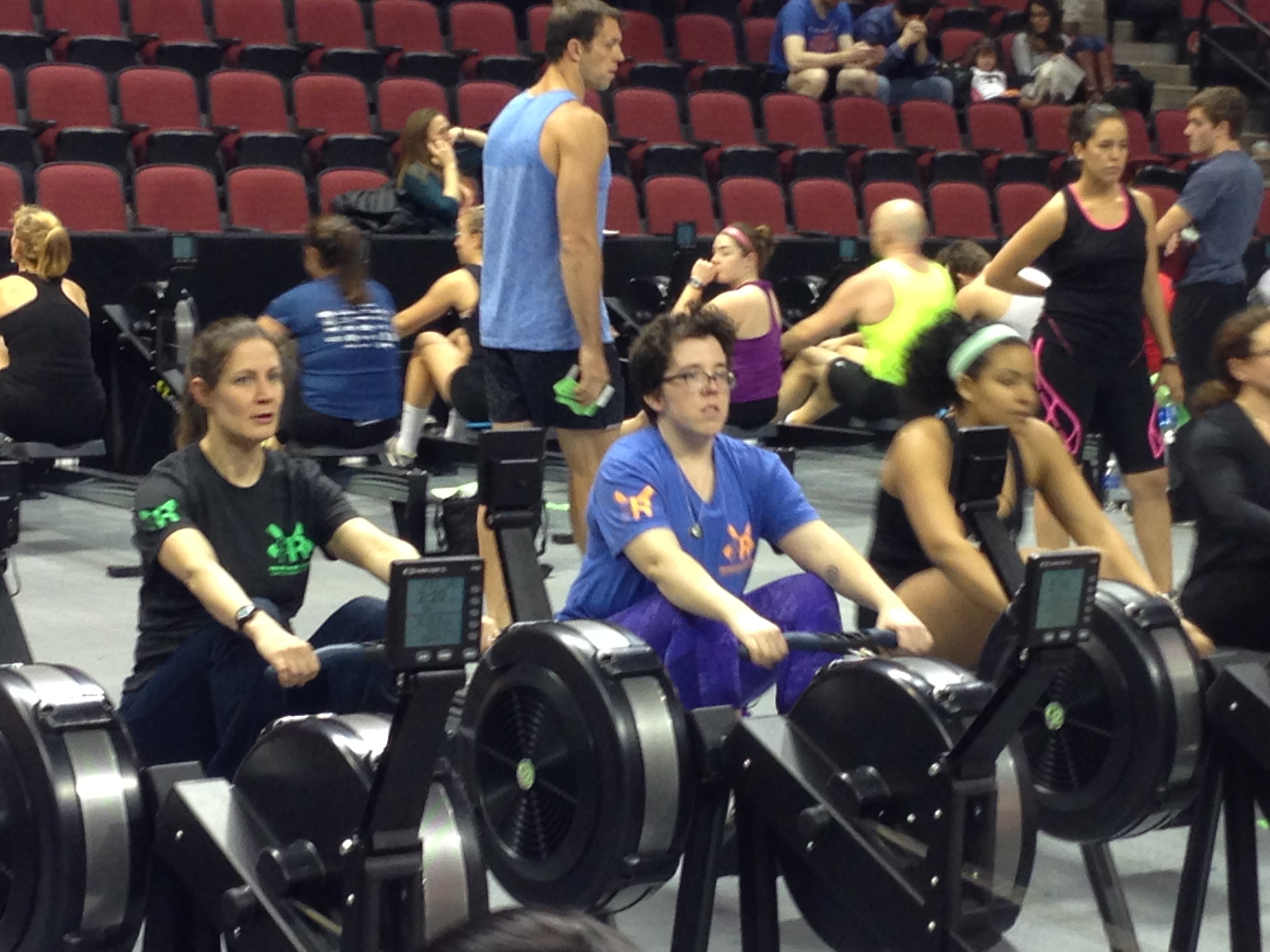
Lauryn and Terese getting in their warm up at CRASH-B 2015

4 x 10 min Spicy Steady State w/ 1 min Rest

10′ @ 18 s/m**

10′ @ 20 s/m**

10′ @ 22 s/m**

10′ @ Increasing Stroke Rating as follows – (5′ @24, 3′ @26, 2′ @28)

**First 3 Pieces – Row 4min Steady, 1min @-3 split seconds, 4min Steady, 1min @-3 split seconds

**Hold the same stroke rating all the way through each piece, but vary the pressure with your legs depending on whether you’re rowing steady or 3 split seconds faster

This is a great opportunity to work on the rhythm and consistent effort needed in long WODs with movements like kettlebell swings and sumo deadlift high pulls.  Focus on maintaining consistent pressure through each stroke and every piece.  Rate of Perceived Exertion should be around 60% – 70%.  Effort level on the last piece is open and should be based on how you feel.  Set the monitor for intervals-time with 10 minutes of work and 1 minute of rest. During the rest stand up and stretch out your back and foam roll any areas that feel overly tense.

Novice rowers should focus on one part of the stroke for each piece, like a horizontal handle path or trying to row feet out.

Vets should be dialing in their consistency.  During the last piece Vets should be focused on bringing their 500m split down as the stroke rating increases.

Post the total distance rowed to comments.