Rowing WOD 6/16: (w/ a partner) 4RFT – 1k Row, 400m Farmer Carry AHAP (Split Work)

Rowing WOD 6/16:

Partner WOD

4 Rounds for Time

1k Row

400m Farmer Carry (AHAP)

(1 person working – Split work however you want)

Post your time to comments!

Today’s Rowing WOD is all about teamwork.  Rowing is the ultimate team sport because if you’re not in sync with your crew then the boat will feel heavy, tip to one side, and not be efficient.  Practice a few quick releases to get out of the straps and have quick transitions with your partner.  Be sure to communicate and work together.  Choose a weight for the Farmer Carry that’s as heavy as possible for both you and your partner.

If you’ve ever wondered what it feels like to row on the water, Renegade Rowing would like to help you out.  Contact Coach Pat (pat@renegaderowing.com) for more details.  Check out the possibilities of combining the two sports we love!

Rowing WOD 6/13

Rowing WOD 6/13:

500m Row

5 Erg Facing Burpees

400m Row

4 Erg Facing Burpees

300m Row

3 Erg Facing Burpees

200m Row

2 Erg Facing Burpees

100m Row

1 Erg Facing Burpee

Today’s Rowing WOD is a beautiful combination of power and coordination.  As the pieces get shorter focus on smooth connection through the catch and powerful hips through the middle.  Same goes for the burpees.  For erg facing burpees practice the quick release to get out of the foot straps, stand next to the erg, do a burpee and then instead of jumping and clapping, jump with both feet over the erg rail.  On the other side drop right down and do it all over again.  This is a shorter WOD, so get after it and push yourself.

Double Under Challenge! – Daily Challenge 5/17


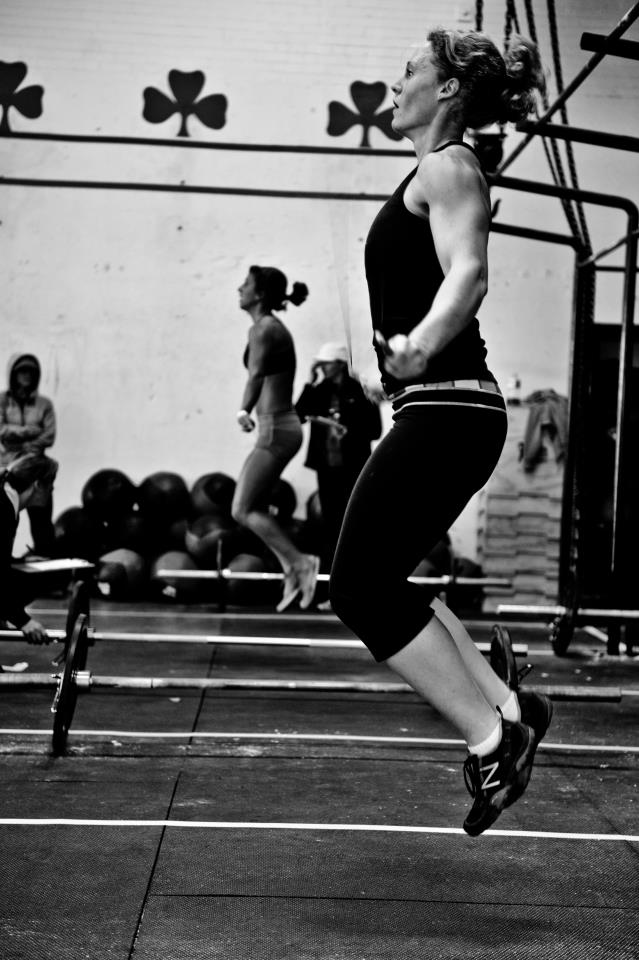
Jump roping is a great way to work on rhythm and timing.  Next time you warmup grab a jump rope and jump for 5 minutes.  Do one minute of singles, one minute alternating feet, one minute backwards, one minute criss cross, and one minute of double unders.  You’ll be breathing and sweating in no time.  Guaranteed to get you ready to crush some Rowing WODs.  Being able to change rhythms from singles to doubles to any other variation is a great way to think about changing up ratio at different stroke ratings and pressures.  Double Unders themselves are awesome because they force you to coordinate you hands and feet separately but in rhythm with each other, just like the catch and the finish.  Check out these Agility Posts for more on jumping, change of direction, coordination, timing, and rhythm.

Agility and Neuromuscular Training as Motor Skill Development

Agility and Neuromuscular Training as it Relates to Rowing

 Daily Challenge 5/17:

Challenge a friend to a double under contest!  Set a clock for one minute and see who can complete the most double unders!

Hang From It! – Daily Challenge 5/15

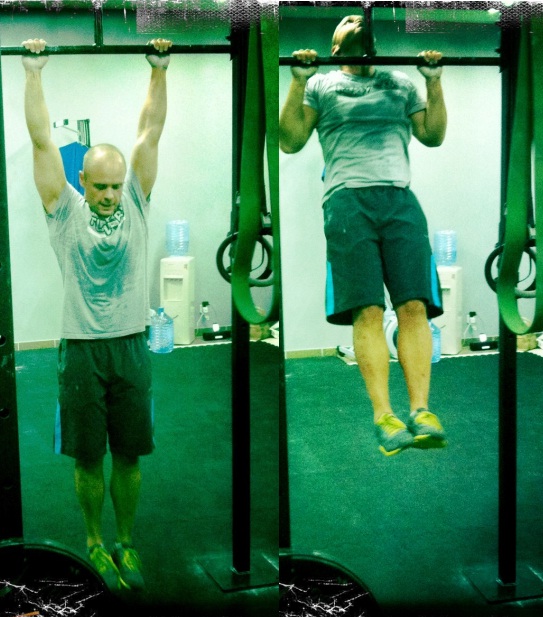
Many rowing coaches will say “Hang From It”, referring to the way rowers hang from the oars as they drive their legs down.  In order to protect our shoulders it helps to build up our ability to keep the lats engaged and shoulders back and down while we hang.  Thus our daily challenge…

Daily Challenge 5/15:

Hang from a pull up bar with your chin over the bar for 3×30 seconds.  If thirty seconds is to long either reduce your hang time or add a light jump stretch band to the mix.

Share your experience!  Was it hard?  Did you keep your scapula retracted back and down?

Deliberate Practice and Intent – Daily Challenge 5/9

Deliberate Practice

Practice is the single most important factor in the control of learning.  Some might think the more we practice the more we learn, but if there is no quality or substance in that practice then learning is slow and tedious.  It has been suggested that at least 10 years of effortful practice under optimal training conditions is required to reach international-level performance (Ericsson, 1996, 2003; Ericson et al., 1993).  Optimal conditions require a well-defined task of appropriate difficulty for the athlete, information feedback, and sufficient opportunities for repetition and correction of errors.  Deliberate practice is a training activity that contains all of these elements (Williams, 2010).

Intent

Deliberate practice isn’t enough to enable athletes to learn a skill correctly.  For a practice to be effective the athletes must be motivated to learn.  Athletes must practice with the intent to improve.  Rowing Fitness allows for this by providing daily competition so that athletes come to practice constantly motivated to improve their performance.  Deliberate practice and the motivation to improve through daily competition is what Rowing Fitness seeks to provide and teach.

Daily Challenge 5/9:
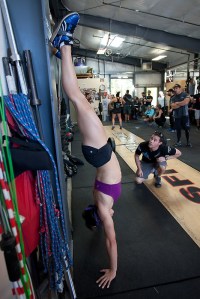
Pick a goat and put in 10 minutes of deliberate practice.

A goat can be any skill in fitness, rowing, or life that is currently a challenge or weakness for you.  Try to focus on one or two aspects of that goat that you can control and improve.
Share what goat you’re working on and what your focus and motivation was during the 10 minutes!

References

Ericsson, K. A. (2003). Development of elite performance and deliberate practice: An update from the perspective of the expert performance approach. In J. L. Starkes & K. A. Ericsson (Eds.), Expert performance in sports: Advances in research on sport expertise (pp. 49-83). Champaign, IL: Human Kinetics.

Ericsson, K. A. (1996). The acquisition of expert performance: An introduction to some of the issues. In K. A. Ericsson (Ed.), The road to excellence: The acquisition of expert performance in the arts and sciences, sports, and games (pp. 1-50). Mahwah, NJ: Erlbaum.

Ericsson, K. A., Krampe, R. T., & Tesch-Romer, C. (1993). The role of deliberate practice in the acquisition of expert performance. Psychological Review, 100, 363-406.

Williams, J. M. (2010). Applied sport psychology (J. M. Williams, Ed., 6th ed.).  Boston, MA: McGraw Hill.