Video Review: Coach Pat – The Push Up, Pull Up, and Rowing – Are you taking advantage of Full ROM?

Coach Pat Push UpsWhen’s the last time you performed a Push Up or Pull Up?  When’s the last time you Rowed?  Now that we’re on the water it’s probably every day.  Regardless, anytime you draw through the finish whether on an erg or in a boat, you are putting your upper body into a similar position and movement pattern as the push up and pull up.  It’s the strongest, most efficient way to get yourself off the floor and send a boat.  If you need to move more weight and create more power in a race you will need a strong position at the finish.  That is where we can take advantage of practicing and training full range of motion push ups and pull ups.

I believe that if you can learn to move your body weight from the floor to a plank position or from underneath a bar to touching the bar with good form, you can and will become a better rower.  The key is how you push, pull, and what you focus on.  Here is a video review of Coach Pat and what he thinks about in regards to push ups, pull ups, and rowing.  Check out what he does well and look for things he can do better.

What parts of these movements can we tie to the rowing stroke?  I always teach the skills of 1. Posture, 2. Control, and 3. Connection whether it’s rowing or strength training.

1. Posture – How am I doing at maintaining a solid brace through my torso?  Is there any movement within the vertebrae of the spine?

2. Control – Is my body in one straight line the whole time I perform the movement?  Am I in control of my body at all points in time? Can I stop at any point in time and be in a strong position?

3. Connection – How are my hands connected to the box/bar/or floor?  How are my feet connected to the floor?  Are my hips, torso, and shoulders connected and moving together through the whole range of motion?

After taking a look and answering some of these questions, think about your own stroke.  In the front end of your stroke, from 1/2 slide up to the catch and back, how do your joints move in relation to one another?  Can you stay connected?  Do you break or tense your arms early?  Is your shoulder and upper body strong enough to connect the power coming from your legs to your hands?  Do you feel or see any similarities when you perform push ups, pull ups, and rowing back to back?  How’s your posture and brace at the finish? Can perfecting these movements help improve your rowing?

Please share your thoughts to comments and I’ll get back to you with feedback.

What are you doing to help move your boat? – Video Review

Now that we’re back on the water it’s time to start thinking about moving boats.  What are you doing at each end of the stroke to help move your boat and maintain maximum boat speed?  Here are two video reviews to help you find opportunities to move your boat better.  One video is of steady state rowing and one video is of race pace rowing.  Take a look and see how they can help you.  What is going well?  What areas can you also work on?  Are you focused on rowing on the erg as if you were going to row on the water?  Please share your thoughts in the comments section and consider joining Renegade Rowing this Spring.

RR Training Plan 3-30-15 and RWOD: “Snow Drifts” – Post Distances

Bring on Summer!

Bring on Summer!

I hope everyone had a solid weekend and you’re ready for more awesome work this week.  Here is our training plan for the week: RR Training Plan 3-30-15

Rowing WOD:

 “Snow Drifts”

2 x 17min w/ 4min Rest

as follows …

5′ @22 s/m, 4′ @24, 3′ @26, 2′ @28, 3′ @26

4min Rest

5′ @20 s/m, 4′ @24, 3′ @28, 2′ @30, 3′ @26

Last week we hit “The Castle” to focus on ratio and rhythm.  Today’s Rowing WOD is another opportunity for everyone to keep working on a sense of form and rhythm without the pressure of intensity and competition.  Sometimes it’s good to slow down and dial in that technique.  Pressure should be a moderate to hard steady state.  That means you can get out short sentences but it’s difficult to maintain a detailed conversation.

In today’s Rowing WOD the focus is developing rhythm and endurance.  Another word for rhythm in rowing is Ratio.  By varying the ratio of the drive to the recovery rowers can maintain the same pace or split, but work more efficiently and make the stroke feel lighter or heavier.

Slingshot Hands Away will be key when we get on the water!

Slingshot Hands Away will be key when we get on the water!

When going from a 26 stroke rating to a 28 you should focus on more pressure with the legs and quickly redirecting the hands through the finish.  Think of a slingshot as you pull the hands in and release them quick and smooth away.  This will help increase the stroke rating while leaving you the same amount of time to sit up, breathe, and relax as you slide forward on the recovery.  When the rating shifts down from a 28 to a 26 be sure to perform a ratio shift and try to maintain the same split.  Focus on pushing a little harder and take an extra second to breath on the recovery to bring the stroke rating down.

Post distance rowed to comments along with songs that helped you stick to each rating!

Music can motivate us to push harder and row longer, but it can also give us a sense of timing.  We might have to start calling it Music Monday’s if this catches on, but for now just have some fun trying to row to the rhythm of the music.  Please add to the playlists any songs that help you stick to a certain rating and keep pushing hard!

Below is the start of a list of songs for various stroke ratings.  If you were to use a music editing program like garage band to clip the songs into segments then you could perform today’s Rowing WOD completely in time to your favorite jams.

If you have Spotify, I’ve created a playlist for each stroke rating.  Each playlist is named “Renegade Rowing @(insert stroke rate)”, so for songs that you could row to at a 20 the playlist is named “Renegade Rowing @20″.  If you have favorite songs that go well at certain stroke ratings please feel free to add to the playlists on Spotify.  Thanks Mike T. for kick starting this project and I hope this helps motivate everyone to find better rhythm and ratio!

20 s/m: Renegade Rowing @20

22 s/m: Renegade Rowing @22

24 s/m: Renegade Rowing @24

26 s/m: Renegade Rowing @26

28 s/m: Renegade Rowing @28

30 s/m: Renegade Rowing @30

32 s/m: Renegade Rowing @32

34 s/m: Renegade Rowing @34

36 s/m: Renegade Rowing @36

Video Review: Coach Pat – The Squat and Rowing – How well do you perform these movements?

One of the First Renegade Rowing Athletes to become a Firsthand Athlete!

One of the First Renegade Rowing Athletes to become a Firsthand Athlete!

When’s the last time you performed a Squat?  When’s the last time you sat in a chair or got in a boat?  For many of you in Boston and the Northern states it’s been a while, but that ice is almost gone and regular water practices will be happening in no time.  Regardless, anytime you sit or stand up you are squatting, because that’s what a squat is.  It’s the strongest, most efficient, most powerful way to get your body up out of a chair or seated position.

I believe that if you can learn to squat correctly you can and will become a better rower.  The key is how you squat and what you focus on.  Here is a little video review of a pre-elite rower I’ve started working with.  This is her form before any coaching. Check out what she’s doing well and what she can do better.

Now take a look at my squat and rowing below.  What parts of the squat can we tie to the rowing stroke?  I always teach the skills of 1. Posture, 2. Control, and 3. Connection whether it’s rowing or weightlifting.

1. Posture – How am I doing at maintaining a solid brace through my torso?  Is there any movement within the vertebrae of the spine?

2. Control – Is the bar traveling in a straight line over the middle of my foot?  Am I in control of my body and the bar? Can I stop at any point in time and be in a strong position?

3. Connection – How am I connected to the bar?  How am I connected to the floor?  Are my hips, hands, and shoulders connected as I go to stand?

After taking a look and answering some of these questions, think about your own stroke.  In the front end of your stroke, from 1/2 slide up to the catch and back, how do your joints move in relation to one another and what does your body angle look like?  How much distance is there between your butt and your heals?  Do you feel or see any similarities when you squat and row back to back?  Can perfecting one movement help improve the other?

Please share your thoughts to comments and I’ll get back to you with feedback.

Video Review: Coach Pat – The Deadlift and Rowing – How well do you perform these movements?

Coxswains getting after the Deadlift last winter!

Coxswains getting after the Deadlift last winter!

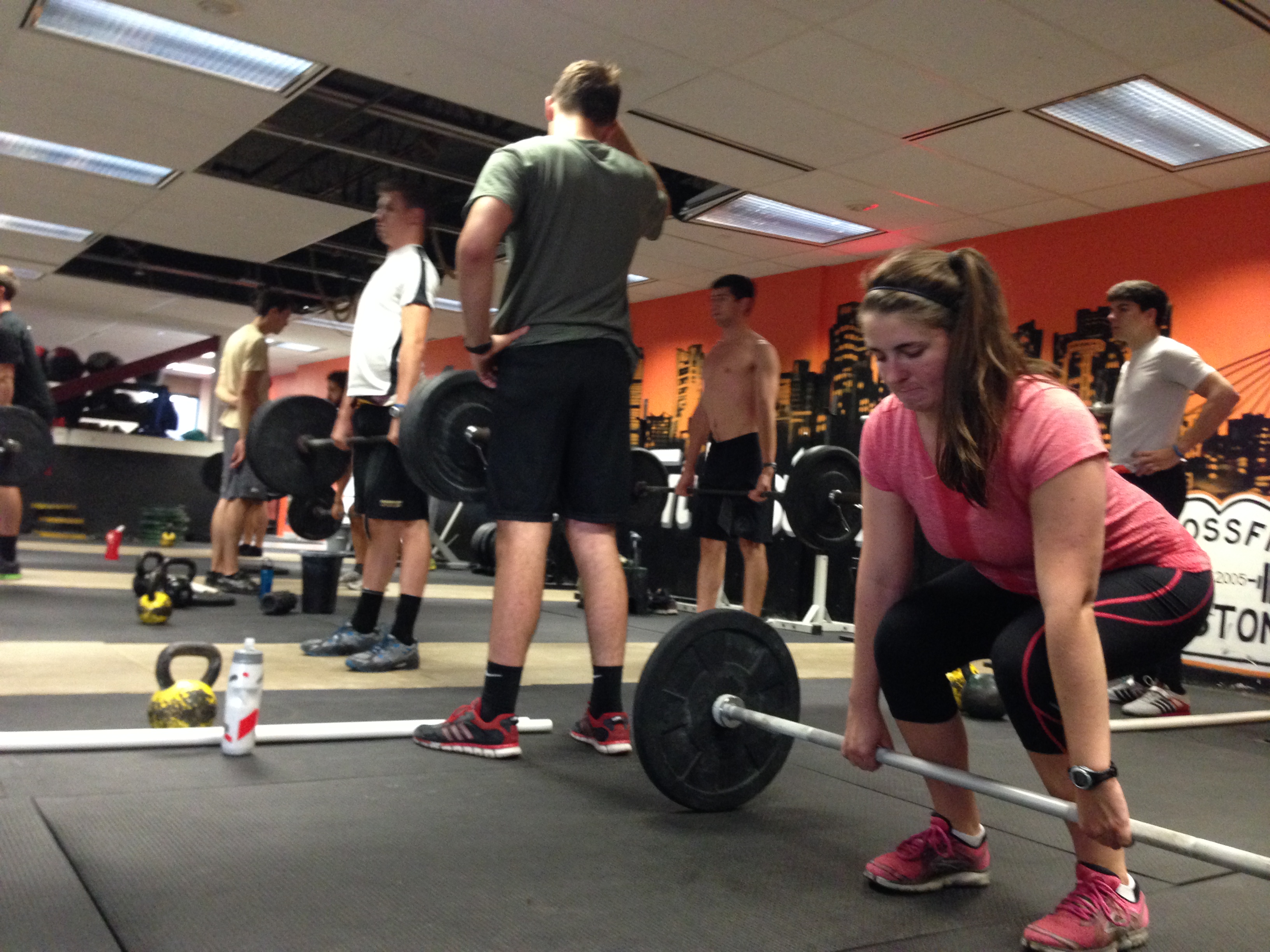
When’s the last time you performed a Deadlift?  When’s the last time you picked the boat up out of the water?  For many of you in Boston and the Northern states it’s been a while, but that ice is almost gone and regular water practices will be happening in no time.  Regardless, anytime you pick something up you should be deadlifting, because that’s what a deadlift is.  It’s the strongest, most efficient, most powerful way to pick something up off the floor or out of the water.

I believe that if you can learn to hip hinge and deadlift correctly you can and will become a better rower.  The key is how you deadlift and what you focus on.  Here is a little video review of a pre-elite rower I’ve started working with.  This is her form before any coaching. Check out what she’s doing well and what she can do better.

Now take a look at my hip hinge and deadlift below.  What parts of the deadlift can we tie to the rowing stroke?  I always teach the skills of 1. Posture, 2. Control, and 3. Connection whether it’s rowing or weightlifting.

1. Posture – How am I doing at maintaining a solid brace through my torso?  Is there any movement within the vertebrae of the spine?

2. Control – Is the bar traveling in a straight line over the middle of my foot?  Am I in control of my body and the bar? Can I stop at any point in time and be in a strong position?

3. Connection – How am I connected to the bar?  How am I connected to the floor?  Are my hips, hands, and shoulders connected when the bar is below the knee?

After taking a look and answering some of these questions, think about your own stroke.  In the front end of your stroke, from 1/2 slide up to the catch and back, how do your joints move in relation to one another and what does your body angle look like?  Does it stay the same?  When does your body start to swing open?  Do you feel or see any similarities when you deadlift and row back to back?  Can perfecting one movement help improve the other?

Please share your thoughts to comments and I’ll get back to you with feedback.