Rest Day 11/8: What’s your goal for the month of November? – Share

Body Preparation

Rest Day 11/8:

What’s your goal for the month of November?

Preparation is the key to reaching peak performance.  To be prepared is to consistently have your thoughts, feelings, and bodily responses at the right state at the right time.  The consistency that is required to reach peak performance and compete day in and day out will never happen if practice and competition behaviors are left to chance.  By creating a systematic approach to how we think about, feel, and react to different situations we can reduce the fear of the unknown and the stress associated with it.  The goal of preparation is to create processes that we can employ daily, weekly, seasonally, yearly, in a warm-up, at practice, in a race, and after competition to improve our readiness to perform.

The first step in preparation is goal setting.  Goals provide direction and purpose.  While it’s important to set goals at the beginning of the season keep in mind that goal setting can be performed whenever we need to focus, to increase motivation, to decrease anxiety, and to increase confidence.  Good goal setting involves a team vision, a mission, or set of values as the ultimate goal.  (The goal of the Renegade Rowing Club is to give rowers the resources, knowledge, and experience needed to compete at CRASH-Bs and then compete on the water come the spring.)   After that there are both long-term and short-term goals.  Last come smaller targets that when reached bring us one step closer to the long or short-term goals.

The Goal Setting Dam

Goal setting can be thought of as a dam that creates a body of water for us to row on.  The targets are small rocks and pebbles that fill in the gaps and support the short-term and long-term goals.  The short-term and long-term goals are larger boulders that provide support to the concrete slab that is the vision, mission, and team values.  When we set goals we pour the concrete slab first, then we set the boulders, then we fill in the small rocks and pebbles.

In order to always have a body of water to row on the dam must be maintained.  Goals only work if they’re looked at regularly.  If targets aren’t being reached or serving a purpose, remove them and replace them with better ones.  The same goes with short-term and long-term goals.  Set goals, but continually reassess them.  We will aim to set and reassess our goals once every month.

When building the dam and setting goals it is important to remember there are two types of goals, process-oriented and outcome-oriented goals.  A process-oriented goal would be getting body preparation by half slide or maintaining a tight lumbar curve through a squat.  An outcome-oriented goal would be winning a championship or squatting 300 lbs.  Our dam should be filled with both, but the more process-oriented goals the stronger the dam.  Process-oriented goals will help us reach our outcome-oriented goals.

Most of All!  Set goals that are …

Most importantly, all goals should have three things in common.  Our goals must be positive, specific, and controllable.  Positive, meaning they “add” and “do” things instead of avoiding them.  Specific, meaning they’re focused, tangible, and not vague.  If needed they could be measured.  Controllable, meaning it is up to us to achieve and manipulate our goals, not some outside force.  We should have the power to affect change and control the goal.  So, start setting goals.  While you do, always ask, are my goals positive, specific and controllable?
Positive, Specific, Controllable

Rowing WOD 11/7: “Row For It!” 3RFT – 750m Row, 15 Deadlifts – Post Time

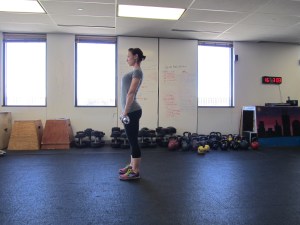
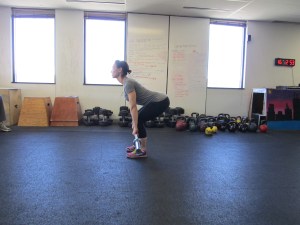
Melissa from CFB demos the setup for a Deadlift

Rowing WOD 11/7:

“Row For it!” (AKA – Fight For It)

3 Rounds For Time:

750m Row (Race Pace)

15 Deadlifts (40% 1RM)

In a 2,000m race the pain really starts to kick in after the first thousand.  If you can be prepared with mental thoughts to stay strong and Fight for your goal split, every stroke for 750m after that first 1k, then you’ll be able to open the flood gates and sprint at 250m to go.  A key to having solid mental thoughts is building confidence in your training leading up to the race.  Have cues to repeat, especially cues that you can attach to specific moments in time or sessions you crushed like today.

Drive through the heels!

In today’s Rowing WOD build and settle to your current 2k split right away.  You want to be in full control of your stroke rating, breathing, and split.  Hold solid, consistent pressure every stroke of each 750m piece.  Know that when things get tough and the pain tells you to stop, you can hold strong and fight for every stroke.  Bring that same focus to your Deadlifts.  Keep a neutral spine and focus on efficient movement through the hips.  Push through the heels and build the speed on the bar as you extend your hips.  Focus on keeping tight abs and feeling the connection of the hips and hands as you pry the bar off the floor.  Try to bring the feeling of a solid deadlift to your rowing and use the cue “heels down” as one motivational thought during that 75om Row.

Post your time to comments and share your mental cues!

Fully extend the hips at the top

Rowing WOD 11/6: 1k Row, 6x250m, 4x:45on :15off – Post # of Strokes at Goal Split

Rowing WOD 11/6:

1. 1k Row @26 s/m

– Moderate Intensity (Row like you’re out for a steady jog)

*Note your average split for 1k

2. 6 x 250m Row w/ :30 Rest

– Row each piece at the average split from the 1k above

– Stroke Ratings are as follows:

@25 s/m, @23 s/m, @21 s/m, @26 s/m, @28 s/m, @30 s/m

3. 4 x :45 On, :15 Off

**Practice each piece as if it were the start of a 2k

**When you settle count the # of strokes where you hold your goal 2k split

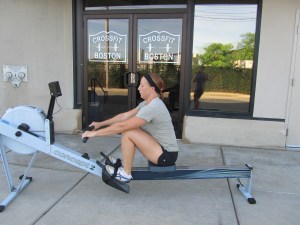
For the first part of today’s Rowing WOD, row at an intensity similar to Jogging focusing on Smooth Form and Body Preparation by 1/2 Slide.  Try to incorporate the work we did on Saturday with Posture, Control, and Connection.  Today we’ll be working on ratio at different stroke ratings and varying the pressure we exert each stroke.  At lower stroke ratings like 20 − 24, the ratio should be 1:2 or 1:3, 1 count on the drive, 2 or 3 counts on the recovery.  By controlling our seat as it slides forward we can make sure we’re preparing our bodies for the catch and turn our force and momentum around without any extra effort.  Remember, we want to drive our body weight backwards toward the finish line, not throw it forward toward the Catch/Start of the Race.

When varying stroke rating during a piece use the pressure with the legs on the drive and the speed of the hands through the finish to vary the rating.  If you want to increase the stroke rating and maintain power, think “drive the legs down faster and quick hands away” out of the finish.  If you want to decrease the stroke rating without losing power, keep the same pressure on the drive and hand speed through the finish, but slow the seat down as it slides forward on the recovery, this is what I mean by “Control the Recovery”.

The goal for these pieces is to learn how to vary the pressure at different stroke ratings while maintaining the same split.  The idea being that eventually we’ll find an optimal stroke rating where you just keep spinning the flywheel every stroke without letting it slow down to much and thus save energy and avoid fatigue.  What we’re ultimately working towards is Efficiency!  Instead of slogging along and duking it out at a slower stroke rating like a 24 for our 2k, we want to be able to row quick and light between a 28 − 32 when needed.

For the third part of the workout you’ll row like the start of a 2k race.  Perform a 3 stroke starting sequence (Half Stroke, 3/4 Stroke, Full Stroke) then a High 10, then settle to your 2k race pace for each of the 4 pieces.  The goal is to learn how to get the flywheel moving and the split down without jacking up your legs.  Then the even bigger goal is learning how to settle immediately to you’re race pace and be consistent.  Count how many strokes you can take at your 2k pace once you settle, no higher, no lower.
In terms of preparing to race 2,000 meters, the goal is to continue building our confidence in maintaining a consistent split as well as develop the ability to change our Ratio/Rhythm as we row at different Stroke Ratings.  We want to get a taste of what the start will be like and what is required to settle to race pace so we don’t Fly and Die!
Post your best :45 second start and settle and how many strokes you take at your goal 2k split.

Rowing WOD 11/5: 4 x 10min Spicy Steady State – Post Total Distance

Rowing WOD 11/5:

4 x 10 min Spicy Steady State w/ 1 min Rest

10′ @ 18 s/m**

10′ @ 20 s/m**

10′ @ 22 s/m**

10′ @ Increasing Stroke Rating as follows

       (5′ @24, 3′ @26, 2′ @28)

**First 3 Pieces – Row 4min Steady, 1min @-3 split seconds, 4min Steady, 1min @-3 split seconds

**Hold the same stroke rating all the way through each piece, but vary the pressure with your legs depending on whether you’re rowing steady or 3 split seconds faster

This is a great opportunity to work on the rhythm and consistent effort needed in long WODs with movements like kettlebell swings and sumo deadlift high pulls.  Focus on maintaining consistent pressure through each stroke and every piece.  Rate of Perceived Exertion should be around 60% – 70%.  Effort level on the last piece is open and should be based on how you feel.  Set the monitor for intervals-time with 10 minutes of work and 1 minute of rest. During the rest stand up and stretch out your back and foam roll any areas that feel overly tense.

Novice rowers should focus on one part of the stroke for each piece, like a horizontal handle path or trying to row feet out. 

Vets should be dialing in their consistency.  During the last piece Vets should be focused on bringing their 500m split down as the stroke rating increases.

Post the total distance rowed to comments.

Rowing WOD 11/3: 6 x 2′ On, 1′ Off (varying rate) – Post Avg Split For Each

Rowing WOD 11/3:

Join the Renegade Rowing Club @CFB Tuesdays at 8pm, Saturdays at 8am!

6 x 2min On, 1min Off as follows:

2′ @ 20 s/m (+9 sec above 2k avg split)

1′ rest

2′ @ 22 s/m (+7 sec above 2k avg split)

1′ rest

2′ @ 24 s/m (2k split +5)

1′ rest

2′ @ 26 s/m (2k+3)

1′ rest

2′ @ 28 s/m (2k+1)

1′ rest

2′ @ 30 s/m (2k)

Today marks the first day of the Renegade Rowing Club for winter training.  Can you believe it?  There are holiday cups at Starbucks, decorations up in stores, and I might have even heard some holiday music on the radio.  The best part of it all is that CRASH-B’s is right around the corner.  Yes, they may not be until February, but time flies over the holidays.  So we’re kicking off winter training today and we’re going to continue to perfect our technique, hone our 2k tactics, and build our confidence to crush that erg every single week until CRASH-B’s.  If you want to join us just follow along and fit a few Rowing WODs in every week, along with your normal training and lifting in the gym.  Choose WODs that will build upon your weaknesses and don’t be afraid to crush your favorites.

Today we’ll review three key skills to rowing on and off the water.  Posture, Control, and Connection.  After a couple of drills we’ll be hitting today’s Rowing WOD.  Really control the stroke rating and fight for the prescribed split.  Be smooth and be consistent every stroke.  During the rest paddle in slow motion, really emphasizing and thinking about the timing of the stroke and where your body is in space.

Post your Average 500m Split for Each Piece to Comments!