Now that we’re back on the water it’s time to start thinking about moving boats. What are you doing at each end of the stroke to help move your boat and maintain maximum boat speed? Here are two video reviews to help you find opportunities to move your boat better. One video is of steady state rowing and one video is of race pace rowing. Take a look and see how they can help you. What is going well? What areas can you also work on? Are you focused on rowing on the erg as if you were going to row on the water? Please share your thoughts in the comments section and consider joining Renegade Rowing this Spring.
One of the First Renegade Rowing Athletes to become a Firsthand Athlete!
When’s the last time you performed a Squat? When’s the last time you sat in a chair or got in a boat? For many of you in Boston and the Northern states it’s been a while, but that ice is almost gone and regular water practices will be happening in no time. Regardless, anytime you sit or stand up you are squatting, because that’s what a squat is. It’s the strongest, most efficient, most powerful way to get your body up out of a chair or seated position.
I believe that if you can learn to squat correctly you can and will become a better rower. The key is how you squat and what you focus on. Here is a little video review of a pre-elite rower I’ve started working with. This is her form before any coaching. Check out what she’s doing well and what she can do better.
Now take a look at my squat and rowing below. What parts of the squat can we tie to the rowing stroke? I always teach the skills of 1. Posture, 2. Control, and 3. Connection whether it’s rowing or weightlifting.
1. Posture – How am I doing at maintaining a solid brace through my torso? Is there any movement within the vertebrae of the spine?
2. Control – Is the bar traveling in a straight line over the middle of my foot? Am I in control of my body and the bar? Can I stop at any point in time and be in a strong position?
3. Connection – How am I connected to the bar? How am I connected to the floor? Are my hips, hands, and shoulders connected as I go to stand?
After taking a look and answering some of these questions, think about your own stroke. In the front end of your stroke, from 1/2 slide up to the catch and back, how do your joints move in relation to one another and what does your body angle look like? How much distance is there between your butt and your heals? Do you feel or see any similarities when you squat and row back to back? Can perfecting one movement help improve the other?
Please share your thoughts to comments and I’ll get back to you with feedback.
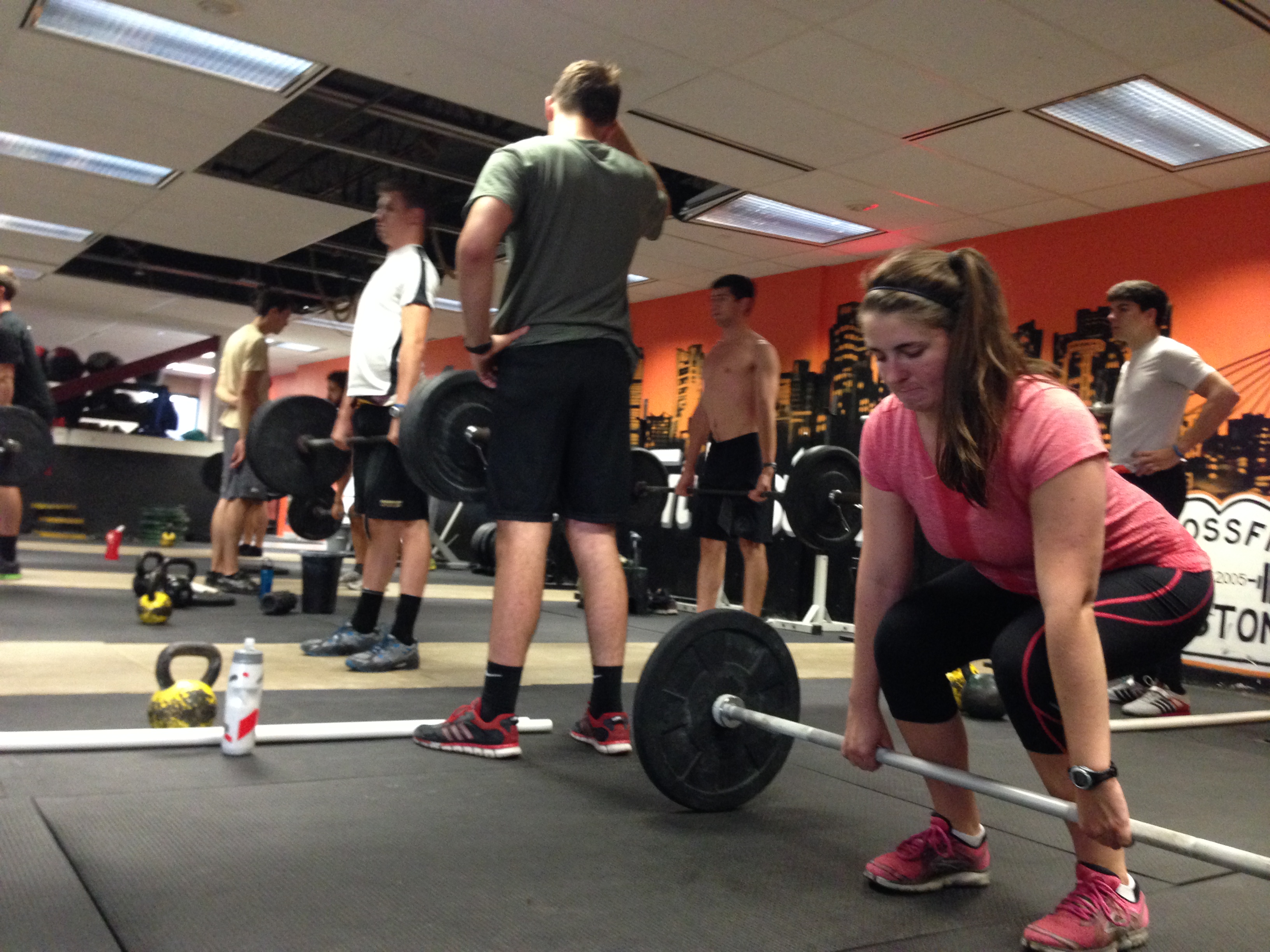
When’s the last time you performed a Deadlift? When’s the last time you picked the boat up out of the water? For many of you in Boston and the Northern states it’s been a while, but that ice is almost gone and regular water practices will be happening in no time. Regardless, anytime you pick something up you should be deadlifting, because that’s what a deadlift is. It’s the strongest, most efficient, most powerful way to pick something up off the floor or out of the water.
I believe that if you can learn to hip hinge and deadlift correctly you can and will become a better rower. The key is how you deadlift and what you focus on. Here is a little video review of a pre-elite rower I’ve started working with. This is her form before any coaching. Check out what she’s doing well and what she can do better.
Now take a look at my hip hinge and deadlift below. What parts of the deadlift can we tie to the rowing stroke? I always teach the skills of 1. Posture, 2. Control, and 3. Connection whether it’s rowing or weightlifting.
1. Posture – How am I doing at maintaining a solid brace through my torso? Is there any movement within the vertebrae of the spine?
2. Control – Is the bar traveling in a straight line over the middle of my foot? Am I in control of my body and the bar? Can I stop at any point in time and be in a strong position?
3. Connection – How am I connected to the bar? How am I connected to the floor? Are my hips, hands, and shoulders connected when the bar is below the knee?
After taking a look and answering some of these questions, think about your own stroke. In the front end of your stroke, from 1/2 slide up to the catch and back, how do your joints move in relation to one another and what does your body angle look like? Does it stay the same? When does your body start to swing open? Do you feel or see any similarities when you deadlift and row back to back? Can perfecting one movement help improve the other?
Please share your thoughts to comments and I’ll get back to you with feedback.
While it’s good to constantly vary your training to push your boundaries, there is something to be said about repetition to build your confidence! Today’s Rowing WOD is an opportunity to build your aerobic capacity and work on a couple of tactical and technique fixes. Have a game plan for each piece including the split and stroke rating you want to hold. Ideally each piece will be done a little bit faster. If you’re working on efficiency or sequencing, focus on one fix each piece. Perhaps you find your breath and rhythm on the first. Or maybe it’s sequencing and body preparation that needs attention on the second. If you choose the right pace it will build your confidence and you will be ready to tear up your next rowing WOD. Below are some goals and times to think about.
Post your splits as well as your fastest and slowest times!
Here is a great warmup for moving in the morning for everyone as they prepare for Spring Rowing and warmer weather! – Moving in the Morning
Rowing WOD:
8 x 500m w/ 2min Rest
Race Pace
Race Focus
Today’s all about prepping for your next 2k. Try to keep a consistent pace over all 8 or “negative split” toward the end if you’re feeling good. Negative splitting means you pull a faster split than you did the last piece.
As a quick review for novice rowers, race pace over 2,000m will be at a stroke rating of 28 − 32 strokes per minute and a consistent 500m split. The lower the split the better. Good things to focus on include breathing, getting the knees down, driving through the heels, quick hands, and being smooth. I also like to coach a smile or grin 10 just to take yourself out of your body for a second, have some fun, and then refocus with a fresh mindset. Focus on one positive thought for 10 consecutive strokes and you’ll be that much closer to your goal.
Post your split for each piece and share what you focused on!



 Renegade Rowing