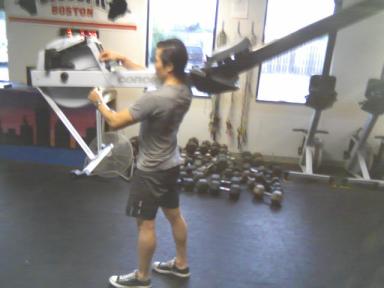
Rowing WOD 6/27: 5 RFT – 1k Row, 100m Erg Carry – Post Your Time!

How will you carry the erg?

Rowing WOD 6/27: 

“Farm Erg”

5 Rounds For Time

1k Row

100m Farmer’s Carry w/ Erg

In CrossFit the Farmer’s Carry can be used to train core stability, grip strength, balance, and coordination.  Usually it’s done lifting odd objects like yokes, water filled pvc’s, sand filled kegs, or any other heavy objects lying around the gym.  Today we’re carrying the Erg.  Ensure you keep a solid core and let us know what you think is the most efficient way to carry an erg 100 meters!

The goal for each 1k Row should be to hold your average split for 2,000 meters plus 2 or 3 split seconds.  In other words, row each piece at a pace of 2k+2 or 2k+3.  Be consistent and work on improving one aspect of your form during each round.

Use this as an opportunity to test out the Undefined Rest feature on your Performance Monitor.  Select Intervals Distance, set the distance for 1,000m and then set the rest to “Undefined Rest”.  This will give you a running clock for the whole workout and allow you to sit down and row 1k each round without having to mess with the monitor.  If your monitor doesn’t have this feature you’ll have to use a stop watch.  Check the blog tomorrow to find out how to update this feature on your monitor.

Post your time and let us know how you carried the erg!

Rest Day 6/24: What’s limiting your catch compression? Share your thoughts?

Rest Day 6/24:

Use a Barbell to work into that calf and heel chord.

What’s limiting your catch compression?

Today’s rest day is an opportunity to work on your mobility through the catch.  Hop on an erg and sit at the catch without the handle.  See how much compression you can get while remaining in a position of strength.  Keep that chest up and shoulders down.  Feel what’s tight and then see if you can work some mobility to get more compression.  After mobilizing retest in the catch position.

A common problem in rowers is limited ankle flexion at the catch.  Here are a couple of things you can use to work on that flexion.  If you have a barbell, try to smash that heal chord and loosen it up by rolling the end of the barbell along the bottom of your calf.  If you don’t have a barbell check out this awesome bone saw calf smash from mobilitywod.com.

Post your thoughts to comments!

Rest Day 6/17: How much do you sleep? Post your thoughts on Sleep!

Sleep – the 6th Food Group

Here’s a great piece on Sleep by Renegade Dietitian Alex Black!

Alright, I know I don’t need to work that hard to convince you that sleep is awesome. I mean, who would turn down the opportunity to get a good night’s sleep or take a nap? Many famous athletes know sleep is awesome too. For example, at most competitions Yelena Isinbayeva, the woman who holds the world record in the pole vault with a jump over 16 ½ feet, warms up and then promptly takes a nap under a towel until her turn to compete. And just this past month I’ve come across some great research on sleep and its role in weight, food choices, and athletic performance. But before I share all this great data, a little on what exactly your body does when you sleep…

Sleep occurs in two parts, non-rapid eye movement (NREM) and rapid eye movement (REM) sleep. NREM sleep makes up about 75% of sleep time and consists of four stages. Stages 1 and 2 are the beginnings of sleep, when your start breathing more irregularly and begin to disengage from your surroundings. Stages 3 and 4 are the parts of the sleep cycle where the most recovery occurs, as breathing slows, tissues are repaired, energy is restored, and important hormones are released. REM sleep makes up the other 25% of sleep time, usually happening 90 minutes after you fall asleep and recurring every 90 minutes. During REM sleep, energy is provided to the brain and body, the brain is active – this is the part of sleep where dreaming happens – while the body becomes immobile as muscles are turned off.

Sleep and Weight In the medical world it’s been widely accepted that people who sleep less are more likely to be overweight. Research has found that people who sleep enough eat on average 200-500 fewer calories than people who don’t. But they didn’t always know why. But now TWO studies that used magnetic resonance imaging (MRI) to look at brain activity found two different ways that sleep may influence what you eat. In both studies, people were assessed after getting enough sleep and after a period of disrupted sleep and in both they were shown images of healthy and unhealthy foods while in the scanner. One study found that the part of the brain that tells us something is rewarding was more active when looking at unhealthy foods after sleeping poorly than it was after sleeping enough. In the other study people who didn’t get enough sleep showed less activity in the frontal lobe, or the part of the brain responsible for making decisions. Basically what these studies tell us is that when you don’t get enough sleep, unhealthier foods look more appealing and at the same time your ability to resist that food may be diminished.

Sleep and Hunger Lack of sleep doesn’t just make you crave uhealthier food, it also influences important hormones that control hunger. These two hormones are leptin and ghrelin. Leptin is stored in fat cells,and low levels of it tell the body you are starving and need to eat more food. Ghrelin is produced by the stomach and stimulates your appetite, again making you want to eat more. Ideally, you’d want to have higher leptin levels and lower ghrelin levels. However research has found that people who sleep less than 5 hours per night on average had lower levels of leptin and higher levels of ghrelin than people who sleep more. This means sleeping less = bigger appetite, on top of any appetite increase you may have from exercising.

Sleep and Sports Performance Last month ESPN published a commentary article calling sleep the new “magic pill”. This claim was based on research at Stanford, which manipulated sleep habits of 11 basketball players and found that when they increased their sleep they sprinted faster, felt better, and saw improvement in three-point shooting and free throw percentages. This is because during deep sleep, the body releases growth hormones that stimulate the building and recovery of bone and muscle. In addition, you need adequate sleep, in addition to getting a good breakfast of course, to have enough energy and good cognitive function, which means more alertness and coordination. Research in Europe a few years ago found that sleep 6 or less hours per night can have the same effects on coordination as drinking alcohol. This can really make a difference when you’re working on technical movements (think rowing, olympic lifts, kipping pull ups).  

So Sleep and Nutrition… Sleep is key to helping you stay on track with a good nutrition plan and making that plan work for you. I have talked about the best nutrition for recovery before, but without adequate sleep it won’t be enough. You can replenish protein and carbs after every workout, but if you’re not sleeping enough your body won’t recover and repair as well as it would with enough sleep. This can leave you fatigued and not able to perform your best. Lack of sleep also makes the healthy recovery options (like nuts, meat, vegetables) look less appealing than the high calorie, low nutrient options like bagels, doughnuts, cookies, cereal etc. So make sure you’re getting enough sleep, especially if you are putting extra demands on your body with training. Experts say that teens need 8 ½ to 9 ½ hours of sleep per night and adults need 7-9 hours to be well rested.

A few strategies to improve sleep It’s not only important to get enough sleep, you need good quality, uninterrupted sleep too. Here are a few things you can do to help:

  • Sleep in a dark room
  • Avoid LCD screens (TV, computer) 15-30 minutes before bed
  • Sleep in a colder temperature
  • Avoid caffeine 4-6 hours before bed
  • Avoid drinking excess water before bed (getting up to use the bathroom will interrupt sleep)

Recipe of the Week: Easy Almond Pancakes

Since we’re talking about sleep, it just feels right to give you a breakfast recipe. I found this through a Google search and modified it to add more flax, which I think makes both consistency and taste better.

Why they’re awesome: These pancakes are quick to make and are still good as leftovers (store in Tupperware in the fridge). Half of this recipe provides 384 calories, 20 grams of carbohydrate and 18 grams of protein. Add a little fruit and you’ve got a great post workout breakfast.

 Ingredients (makes 2-3 servings)

2 eggs

2 tablespoons water

½ tablespoon honey

2 teaspoons vanilla extract

½ cup almond meal

½ cup golden flax seeds

¼ teaspoon baking soda

Coconut oil

Heat a skillet over medium heat. Whisk the liquid ingredients together. Add the dry ingredients and stir well. Melt about 1 tsp coconut oil into the skillet. Spoon mixture onto pan, making sure pancakes are pretty flat (thicker ones end up leaving a gooey center and burnt outside). Cook until firm enough to flip over and then cook another 30 – 60 seconds. Top with berries or whatever else you’d like. 

Do you have timing? – Timing Your Nutrition

Here’s another great post from Renegade Dietitian Alex Black!

Timing Your Nutrition

Timing is a crucial part of almost every sport.  Baseball players must swing at the right time to connect with the ball and get a hit. Olympic lifters need to pull and drop under the weight at the right time to make a lift. And rowers focus on maintaining a steady pace and stroke rhythm while keeping in sync with the boat.  In much the same way that you would make and execute a race plan for a 2K test, it is important to plan when and what you eat surrounding workouts. In this post I’ll discuss the best foods to eat and when.  That way you can keep having awesome workouts.

Before a workout your body should have a topped off fuel tank. This means you should have enough glycogen (the body’s stored form of carbohydrate) stored as well as some more readily available from food. In general, pre workout meals or snacks should be:

  • Enough energy to prepare you for the workout without leaving you hungry or with undigested food in your stomach
  • Low in fiber and fat
  • Higher in carbohydrates
  • Moderate in protein

Meals low in fat and fiber will allow your stomach to empty in time so you can avoid stomach discomfort. The carbohydrates will top off glycogen stores, maintain blood sugar levels, and provide energy.  Protein will help you avoid hunger. In addition, it is important to be hydrated before exercise. The recommendation is that athletes drink 2-3 milliliters of water per pound of body weight at least 4 hours before working out to hydrate and get rid of any excess fluid (Rodriguez et al 2009). This means a 140 pound athlete should be drinking 280 – 420 milliliters of water, or about 1-2 8 ounce glasses or one standard 16.9 ounce water bottle (the smaller one typically found in your average convenience store fridge). For more on finding your hydration needs see my post on Hydration.

How much you need to eat depends on what time of day you workout and the volume and intensity of that day’s training. Many athletes have early morning workouts, and while you don’t need a big breakfast beforehand it is important to eat something. A snack with at least 30-60 grams of carbohydrate and 10-15 grams of protein with little fat and fiber should be sufficient. Try packing something convenient the night before so you can avoid missing your snack if you wake up too late (trust me, this is bad news). Good ideas include fruit, like an apple, peach, or banana paired with lean protein such as deli meat or jerky. You can also pack a few ounces of meat leftover from dinner.  I have done dried fruit and nuts or sunflower seeds but this may be too much fat for some people.

On the other hand, if your workout is later in the day or higher in volume or intensity you will need to eat a little more. If you are exercising within 2-3 hours of a meal then that meal should be sufficient so long as it provides adequate carbohydrates and protein. If 4 hours or more pass between a meal and a workout, add in a snack 1-2 hours beforehand so you will have enough energy and avoid being hungry. In general, carbohydrate intake should be higher surrounding workouts and lower throughout the rest of the day.

The key to remember is that finding a pre workout meal/snack that works for you is trial and error: experiment with a few things and stick with the ones that work. A meal that “works” will be convenient, provide enough energy to keep you going, and leave you free of cramping or stomach pain.

During the Workout Whether or not you need to take in energy during a workout depends on how long that workout lasts. For workouts one hour or less, maintaining hydration with water alone should be sufficient. For longer workouts recommendations suggest taking about 30-60 grams per hour (Stellingwerff et al 2011). Carbohydrate during a workout should be taken in small amounts in 15-30 minute intervals to avoid any stomach issues. The best options during a workout are high carbohydrate, low-fat foods like fruit or sports drinks.

Post Workout/Recovery is the most important time, as it is the time when your body reaps the benefits of all the hard work you’ve done. During the workout your body burns through your stored glycogen, you lose fluid to sweating, and muscle tissue is broken down. Recovery is when you can replenish your stored glycogen, replace lost fluid, and rebuild damaged muscles.

Within one hour of a workout you should aim to have 30-60 grams of carbohydrate and 15-20 grams of protein, and then repeat this every two hours for 4-6 hours (Rodriguez et al). So if you workout at 6 am, this could be met by eating 3 of the following times: post workout snack, breakfast, mid morning snack, or lunch.  Try to eat something that not only provides these nutrients but also provides vitamins and minerals. Research has shown that chocolate milk may be a good recovery option because the milk provides calcium and magnesium, two minerals important in muscle contractions, and potassium, which is an important electrolyte lost in sweat. So while a bacon, egg, and cheese bagel from Dunkin Donuts will provide the carbohydrates and protein you need, it provides little nutritional value in terms of vitamins, minerals, and electrolytes. Better snack options are fruit smoothie with yogurt or protein powder or deli meat or jerky and fruit. If you plan on eating a meal within an hour of working out, this can serve as your recover snack. Try a veggie omelet after a morning (or evening  – who doesn’t love breakfast for dinner) workout… you won’t be disappointed!

To Wrap it up…  

Eating good foods in the right amounts at the right time is important because you can’t out train a bad diet. So, the key things to remember are:

  • Eat enough before workouts so you have energy to crush them
  • Recover smart after the workout, so you will be ready and healthy to crush the next one
  • Choose whole, non processed foods as much as possible to give your body the vitamins, minerals, and antioxidants it needs

Recipe of the Week: Easy Pulled Pork

Why it’s awesome: It’s easy to make, tastes good hot, cold, or several days later as leftovers (if it lasts that long) and leaves a lot of room for flexibility. I’ve never made it with the same BBQ sauce and it’s come out great every time.

Ingredients

4-5 lbs of pork shoulder
McCormick’s Pork Rub
1/2 liter of diet ginger ale

1 ½ cups of water (optional: can use beer in place of water)
barbeque sauce (look for one that is HFCS-free and has a short, simple ingredients list)

Place meat in slow cooker. Pour in ginger ale and water (or beer) and add 2 TB of
pork rub. Cook on high 6-8 hours (I usually do 7). Remove meat and
pull apart using 2 forks. Remove undesirable pieces and place good
pieces in a casserole dish. Add pork rub (I use about 3 spoonfuls, but
it’ll depend on how spicy you like it and how much meat you used) and
barbeque sauce (I usually use the whole bottle but again, it’s per
your taste) and toss until it’s all mixed. Cover with foil and bake at
350 for 25-30 minutes.


Sources

1. Rodriguez NR, DiMarco NM, Langley S; American Dietetic Association; dietitians of Canada; American College of Sports Medicine. Position of the American Dietetic Association, Dietitians of Canada, and the American College of Sports Medicine: Nutrition and athletic performance. J Am Diet Assoc. 2009 Mar;109(3):509-27.

2. Stellingwerff T, Maughan R, Burke L. Nutrition for Power Sports: Middle-distance running, track cycling, rowing, canoeing/kayaking, and swimming. Journal of Sports Sciences. 29: Supp 1, S79-S89. 
Continual Learning – DC 5/24

Learning

Learning is a life long endeavor and is the essence of life itself.  With proper learning comes a sense of well-being and happiness.  Learning feeds into our preparation and improves our performance.  Plato believed that knowledge is already within us and learning is the process of uncovering it through recollection.  Recollection occurs through searching and questioning.  Why did that performance stink, or why was it so great?  What worked in our preparation and what didn’t?  We must be brave enough to challenge our long-held beliefs and keep open minds so that we can improve our preparation and performance.

Plato

Plato stated, “For true opinions, as long as they remain, are a fine thing and all they do is good, but they are not willing to remain long, and they escape from a man’s mind, so that they are not worth much until one ties them down by (giving) an account of the reason why.”  Our learning will focus on tying down our personal experiences and figuring out what works for us as a team and individuals.  The tools we’ll use include journaling and self-evaluation.

Daily Challenge 5/24:

Learn from a performance!  

It can be at home, work, in the gym, or on the water.  Figure out what worked and why.  Use the following tool to help you out!  Share your thoughts on Learning!