Nutrition for Athletes: The Macronutrients – DC 5/23

Nutrition for Athletes: The Macronutrients

Energy in food comes from three nutrients called macronutrients: carbohydrates, protein, and fat. Each one plays a different but important role in helping your body function, perform, and recover optimally. In this post I’ll breakdown what each nutrient does, how much of it you need, and the best food sources. Next week I’ll talk about how to time the intake of these nutrients for the best performance and recovery.

Carbohydrate 

Carbohydrates provide fuel and are the body’s most readily available source of energy. When you eat carbohydrates, the body breaks them down into the simple sugar glucose, which is then transported throughout the body to provide energy, fuel important reactions, and maintain blood sugar levels. Any glucose not used immediately is stored in your liver as glycogen. During quick bouts of exercise, like a 100 meter sprint, the body uses glucose as the main source of fuel. But when it needs additional energy during longer workouts, it will draw on its glycogen stores, as well as stored fat, for energy. Having enough glycogen stored up for the body to use will allow you to perform at your best, both in competition and training. On the other hand, not getting enough carbohydrates and energy to meet your needs over an extended period of time can weaken your immune system – meaning you could get sick more often – and make you feel less energetic.

Carbohydrates come from a variety of sources, and some are better than others. Some of the better sources of carbohydrates include fruits and vegetables, starches like sweet potato, and some whole grains. Fruits and vegetables are the best sources of carbohydrates because they have more fiber and other nutrients like vitamins and minerals and are less energy dense. If you choose grains, make sure they are 100% whole grains like brown rice, quinoa, whole wheat bread or pasta, etc. The carbohydrates to avoid include baked goods, simple sugars (like table sugar and syrups), processed grains (or “white” grains), and other processed snack foods.

How much carbohydrate you need depends on the intensity and volume of training, gender, and type of sport. Research indicates that athletes need 6-12 grams of carbohydrate per kilogram of body weight (weight in kilograms = weight in pounds divided by 2.2). Women and less active athletes will be on the lower end of that range, while men or endurance athletes will be on the higher end. So for example, a 140-pound female rower doing intense preseason training would try to eat around 8 grams of carbohydrate per kilogram of body weight, or close to 500 grams of per day. However the same athlete would need about 380 grams of carbohydrate (6 grams per kilogram of weight) per day during the less intense off-season, and less than 6 grams per kilogram during times of inactivity like rest, vacation, or injury.

Protein

Protein is involved in many important reactions occurring in the body and is a primary component of hair, nails, DNA, and muscle. Not eating enough protein to meet your needs over time can lead to problems such as low energy levels, slowed healing of wounds like bruises and cuts, greater than normal muscle soreness, and trouble sleeping, among other things.  Athletes need protein to allow the body to recover and repair muscle fibers broken down during training. In addition, protein requires more energy to digest than carbohydrates or fat and has been shown to help moderate blood sugar levels and help maintain satiety. What his means is that protein not only rebuilds muscle and aids recovery but also helps you stave off hunger after meals and keeps you from having the dreaded “crash” you get a few hours after eating a high sugar food like a bagel or doughnut. 

The best sources of protein are lean animal products including chicken, lean beef, turkey, buffalo, fish and eggs. Protein is made up of chains of smaller units called amino acids, and of the 22 known amino acids 9 of them are not made by the body and must be obtained from the diet. Only animal products contain all 9 of these essential amino acids. You can also find protein in nuts and nut butters, seeds, soy, and dairy products however these items offer less protein and can have more sugar or fat per serving.

Protein needs vary depending on sport, gender, and volume of training. Current recommendations suggest that athletes need 1.2-1.7 grams of protein per kilogram of body weight. As with carbohydrate needs, women and those doing less volume will be on the lower end of that range while men and higher volume strength and endurance athletes will be on the higher end.

Fat
Fat is the body’s stored form of energy. During longer, moderate exercise like running, up to 50% of the body’s energy can come from fat metabolism. It is a key part of cell membranes, helps protect organs, and aids in the absorption of four key vitamins: A, D, K, and E. Fat slows down the rate that food is digested, and like protein helps moderate blood sugar and maintain fullness. But not all fats are created equal!

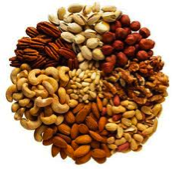
The good fats, unsaturated fats, include oils, nuts and nut butters, and fatty fish. One type of unsaturated fat – omega 3 fat – has been shown by research to help brain function and cognition, reduce inflammation, and reduce the risk of heart disease and cancer. You can find them in cold water fish like salmon and mackerel, flax seeds, pumpkin seeds, nuts, and plant and nut oils. The bad fats, or saturated fats, are solid at room temperature and include butter, mayonnaise, and salad dressing. Saturated fats are also found in higher fat meats. It’s important to remember that some saturated fat is okay, especially if it comes from red meat since red meat provides other important nutrients like iron (to prevent anemia) and zinc (helps with healing and immune system function). But wait! There is one exception to this rule, and that is coconut oil. Coconut oil is a saturated fat, but it is structured differently than other fats, making it easier to absorb during digestion. It has no negative effect on cholesterol like other saturated fats and has been reported to protect against heart disease, promote a healthy weight, and boost immune system function. There are no set recommendations for fat intake for athletes, but the important thing is making sure you get enough healthy fat, especially omega 3’s, by including nuts, seeds, oils, avocado, and meat in your diet regularly. Avoid fat from sources like baked goods, fried food, and fast food.  

And now for the recipe and daily challenge! On Monday coach Pat discussed the importance of preparation. Preparation is key for staying on track with a healthy diet, as oftentimes the “convenience foods” are the least nutritious. It takes effort and planning to get all the nutrients you need but it’s well worth it!

Daily Challenge 5/23: 

Plan to get a serving of omega 3 fats today!  Eat some fish like salmon, tuna, or halibut, or some nuts. Add flax seeds to your oatmeal or yogurt. Comment and tell us what you did! Also comment with any questions.

Recipe of the Week: Easy Spicy Salmon and Mashed Sweet Potatoes

I found this recipe online and it’s my new go-to when cooking salmon. The ingredients are in most pantries and prep time is short. This meal makes 3-4 servings and provides the protein and carbohydrate you need to recover as well as a serving of omega 3 fats. Add some green vegetables or a salad for a completely balanced (and awesome) meal!

Ingredients

1 lb salmon filets

1 clove garlic, minced

2 TB onion

1 ½ tsp pepper

¾ tsp paprika

¼ tsp cayenne

¾ tsp dried thyme

¼ tsp salt

1 TB olive oil

3 medium sweet potatoes

 Cinnamon to taste 

Salmon – Combine all the seasoning ingredients and mix well. Spread over salmon and bake skin side down 20-30 minutes at 350 degrees.

Sweet Potato – wrap 3 sweet potatoes in foil and bake at 400 degrees for 45 minutes, or until you can easily poke them with a fork. Let cool a few minutes. Unwrap and mash with potato masher. Add cinnamon to taste. Tip: Make the sweet potatoes the night before and reheat to avoid a traffic jam in the oven.

What are you talking about? – Performance and Self Talk – DC 5/22

Performance

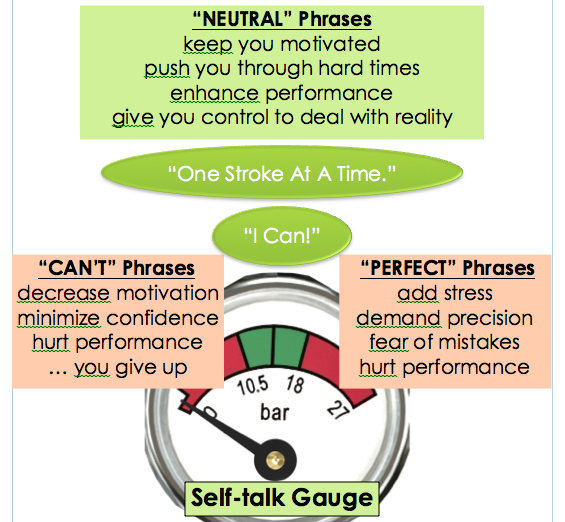
Performance is the beautiful moment in sport when an athlete gets to put it all together.  Performance is the combination of mind and body, of physical and mental preparation.  Performance is when an athlete gets to challenge the skills they’ve learned in order to feel total immersion in the activity.  Those who perform best experience a narrow focus of attention on the present and no fear of failure.  Exceptional performance feels like complete control, the slowing of time, and the feeling of everything being automatic and effortless.  To perform well athletes must have control over emotion, thoughts, and arousal.  They must exist in a state of high self-confidence, be physically and mentally relaxed, and highly energized.  Some of the tools we’ll use to improve performance include concentration and self-talk.

Self Talk

Self-talk is that “voice inside your head” otherwise known as your thoughts.  The mind controls the body and being aware of what that voice is saying can improve performance.

Daily Challenge 5/22:

Check Yourself!  During your work today, whether it be in the gym, a meeting, or at home, make sure you’re using positive self talk and not adding undue stress to your performance.

Post your thoughts to comments.  How does self talk affect your performance?

Understanding Food Labels – Daily Challenge 5/18

Here’s a great post on food labels by Renegade Dietitian Alex Black…Check out the daily challenge at the end and share your thoughts!

Understanding Food Labels

Food labels can be confusing. There’s a lot of information in a small space, and a sometimes lengthy and confusing ingredients list. Sometimes it feels like you need a well-honed set of detective skills and a chemistry textbook to decide whether or not something is a healthy choice. This week the Huffington Post published an article on “Gross Ingredients in Processed Foods” (read it here http://www.huffingtonpost.com/2012/05/11/gross-ingredients-processed-foods_n_1510516.html) and it got me thinking about all the crazy stuff that can end up in our food. Just a few weeks ago I challenged some Renegades to guess the identity of a food given the nutrition information and ingredients, and they were surprised to see how many ingredients could be added to something as simple as peanut butter. The beauty of eating whole foods (fruits, vegetables, meat, nuts and seeds, etc) is that you don’t have to worry about a confusing label! But hey, sometimes packaged food happens, so below are some general guidelines for reading a nutrition label and some information about a few of the more commonly added ingredients.

The Nutrition Label

You don’t have to inspect every piece of information on the label if you pay attention to a few key numbers…

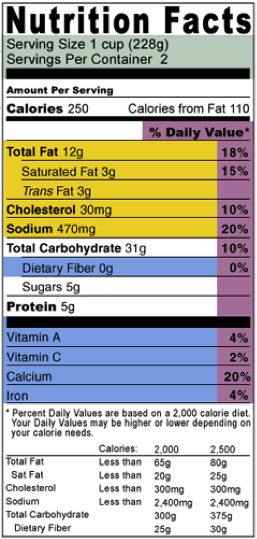
The first thing you want to look for is the serving size and servings per container so you know what type of portion you are working with. Pay extra attention to servings per container if you’re buying an individually packaged food (like nuts or trail mix from a convenience store), as they are often 2-4 servings per package.

Next look at calories. For the most part, try to limit foods that are high in calories but small in serving size. For example, ¼ cup of Naked Granola, or about 1 large handful, is 150 calories. That’s the same amount of calories in a banana and 1 tablespoon of nut butter. Which one sounds more filling? Note that whole nuts are the exception to this rule, as while they are energy dense, they also contribute to satiety and provide healthy fats, protein, and vitamins.

Now look at fat. Avoid packaged foods high in saturated fat and anything containing trans fat. If you’re looking for a snack to eat less than 2 hours before a workout, choose something lower in total fat, as a higher fat snack close to a workout could cause stomach pain and discomfort.

Finally, check the carbohydrate, sugar, and fiber content.  Ideally you want a food that is lower in sugar and higher in dietary fiber. Try to pick foods with less than 5-7 grams of sugar per serving. And if you are eating within 1-2 hours of a workout, choose something a little lower in fiber (less than 5 grams total) as this can, along with fat, cause stomach discomfort during the workout.

Also worth noting are the vitamins and percent daily values (DV). Percent Daily Values are based on the requirements for an adult consuming a 2,000 calorie diet. Even if you are eating less or more than that, they are still useful as an indicator that a food is high or low in a certain nutrient. If a food contains less than 5% of the DV it is low in that nutrient and if it contains greater than 20% DV it is high in that nutrient. Look for foods that are high in vitamins and minerals and low in sodium and cholesterol. There are no daily values for trans fat or sugar.

Ingredients 

It is also important to look at the ingredients list when comparing foods, as oftentimes there are “hidden” ingredients that you wouldn’t think to look for, like when there is added cane sugar, salt, and hydrogenated oil in your “natural” peanut butter. Foods are listed on the ingredients list in order of percentage by weight, so pay attention to the first few ingredients, as they usually make up the bulk of the food. You may also see “contains less than 2% of” followed by a list of items, and these are usually preservatives or additives to improve the texture and shelf life of the food. Here are a few things you will frequently see on ingredients lists:

High Fructose Corn Syrup, also known as HFCS, is made when corn is reacted with certain enzymes to convert some of the glucose to fructose. Over the past 30 years it has been added to a wide variety of processed foods in place of table sugar, known as sucrose. HFCS only contains 5% more fructose than sucrose and proponents of HFCS claim that the body cannot tell the difference, stating that no research can prove HFCS directly causes obesity. However, HFCS is typically associated with food products high in sugar, saturated fat, and empty calories, and since its addition to food production, obesity rates have skyrocketed. For the most part, HFCS and the foods that contain it should be limited.  

Soy Lecithin is extracted from soybeans and is a byproduct of soybean oil production. It is used in foods as an emulsifier, or something that keeps oil and water based ingredients from separating. Most often it is used in candy bars to keep cocoa and cocoa butter and in baked goods to help dough rise and make it less sticky. It is typically less than 1% of the food by weight and does not appear to have negative effects. In fact, it is high in choline, a nutrient also found in egg yolks and thought to improve brain and heart development. Some people use it as a supplement. While this ingredient is not inherently unhealthy, it is often found in baked goods, which are high in processed sugar and low in other nutrients.

Mono and di glycerides are fats from oils and are used as emulsifiers in foods like potatoes, chewing gum, and margarine. They are also used in baked goods to keep them from getting stale and extend the shelf life of food products. Mono and di glycerides may also contain trans fats.

Xantham Gum is a polysaccharide, this time formed from fermentation of bacteria (the same bacteria that causes vegetables to rot). It is used as a thickener in salad dressings and dairy products, helps keep crystals from forming in ice cream, and simulates a “fat feel” in some low-fat or nonfat dairy products.

Sorbitol is a sugar alcohol found naturally in some fruits (apples, peaches, prunes) but is also an artificial sweetener added to foods to improve sweetness and preserve shelf life. It can be found in many diabetic friendly foods, sugarless gum, and “low sugar” or “sugar free” items. Sorbitol is absorbed very slowly, and only some of it actually gets digested. Although it is found naturally in some foods, be careful with sorbitol, as it has a laxative effect if consumed in excess.

The most important thing to remember is that when it comes to food, simpler is always better! When comparing similar foods, pick the one with the shorter ingredients list.

This brings me to today’s challenge – NAME THAT FOOD.

Daily Challenge 5/18:

Name the following food!

Given the following nutrition label and ingredients list, can you tell us what food item this is? Post your answers to the comments, and I’ll give you the answer at the end of the day. The first person to comment the correct answer, or whoever gets the closest by the day’s end, gets a bonus point and a fist bump from coach Pat.

Nutrition Facts (for 1 serving)

Calories   100

Total fat   3 g

            Saturated fat   1 g

            Trans fat   0 g

Cholesterol   0 mg

Sodium   75 mg

Total Carbohydrates   17 g

            Sugar  7 g

            Dietary Fiber   1 g

Protein   2 g

Ingredients

GRANOLA (WHOLE GRAIN ROLLED OATS, BROWNSUGAR, CRISP RICE [RICE FLOUR, SUGAR, SALT, MALTED BARLEY EXTRACT],WHOLE GRAIN ROLLED WHEAT, SOYBEAN OIL, DRIED COCONUT, WHOLE WHEATFLOUR, SODIUM BICARBONATE, SOY LECITHIN, CARAMEL COLOR, NONFAT DRYMILK), SEMISWEET CHOCOLATE CHIPS (SUGAR, CHOCOLATE LIQUOR, COCOABUTTER, SOY LECITHIN, VANILLA EXTRACT), CORN SYRUP, BROWN RICE CRISP(WHOLE GRAIN BROWN RICE, SUGAR, MALTED BARLEY FLOUR, SALT), INVERTSUGAR, SUGAR, CORN SYRUP SOLIDS, GLYCERIN, SOYBEAN OIL. CONTAINS 2% OR LESS OF SORBITOL,CALCIUM CARBONATE, SALT, WATER, SOY LECITHIN, MOLASSES, NATURAL AND ARTIFICIAL FLAVOR, BHT (PRESERVATIVE), CITRIC ACID.

*****Answer******

Quaker Chewy Chocolate Chip Granola Bar

Handstand Challenge! – Daily Challenge 5/16

On Monday I had the privilege of attending the CRI Comp Girls practice.  Both the Varsity and Novice teams competed for CrossFit Boston Tanks and kicked some but.  They did 1 minute of squats and 1 minute of push ups.  The winning score for both teams was 92!  Awesome!

While waiting for the Novice Girls to finish racing each other in a van push competition, I was challenged to a Handstand Competition.  I’ve been working on my hand stands, but my challenger crushed me.  I think I might have held a hand stand for two seconds, but she obviously had some gymnastic skills and could hold it for more than 5 seconds.

I had a blast!  Thanks CRI Ladies!  I can’t wait to see you crush it this weekend at Regional’s and hopefully I’ll see some of you at Renegade Rowing in the near future!

So, without further ado …

Daily Challenge 5/16:

Challenge a friend to a Handstand Competition!  Who can hold a handstand the longest?  3,2,1 Go!

Share your experience!

Life and Balance – Daily Challenge 5/10

Life and Balance

Life is a balancing act.  In order to be happy and healthy there must be a balance in all areas of our life, Self, Family,School, Work, Friends, Sleep, Nutrition, etc.  Excessive focus on any one area can lead to the downfall of the others.  Remember that too much of a good thing can be bad.

Daily Challenge 5/10:

Call a family member or friend you haven’t been in touch with for a while.

Tell them what you’ve been up to!  Find out what they’ve been up to.  Figure out when you might see them again.  If you need something else to talk about tell them about rowing and fitness!  

Don’t think twice about this challenge.  The first person that pops into your head call!  Not only will it improve your balance, but it will probably improve theirs.

Ready Go!  

Afterwards let us know your thoughts on life and balance and how you try to achieve it.